British Little Boy Who Thinks the Baby Will Be White Vine
Birthmarks are coloured marks on the peel that are present at birth or soon afterwards. Most are harmless and disappear without treatment, just some may demand to be treated.
Types of birthmark
There are many dissimilar types of birthmark.
Flat, red or pink areas of peel (salmon patches or stork marks)
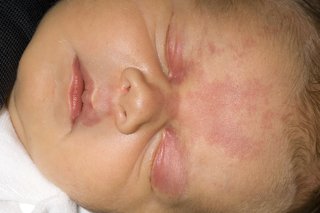
Salmon patches:
- are carmine or pink patches, often on a infant'due south eyelids, caput or neck
- are very common
- look red or pink on calorie-free and dark skin
- are easier to see when a babe cries
- normally fade by the historic period of 2 when on the forehead or eyelids
- can take longer to fade when on the dorsum of the head or cervix
Raised carmine lumps (strawberry marks or haemangiomas)
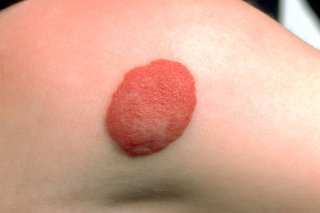
Strawberry marks:
- are blood vessels that grade a raised red lump on the skin
- announced soon after nascence
- usually wait red on light and dark peel
- are more common in girls, premature babies (built-in earlier 37 weeks), low birth weight babies, and multiple births, such as twins
- get bigger for the outset six to 12 months, and then shrink and disappear past the age of 7
- sometimes announced nether the pare, making information technology look blue or purple
- may need treatment if they impact vision, breathing, or feeding
Red, majestic or dark marks (port wine stains)
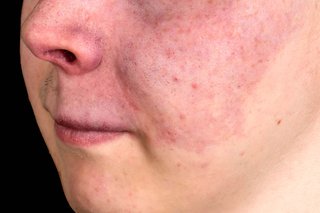
Port vino stains:
- are reddish, majestic or dark marks and usually on the face and neck
- are present from birth
- wait like very nighttime patches on dark skin
- usually affect ane side of the torso, only can bear on both
- tin sometimes be fabricated lighter using laser treatment (it's most effective on young children)
- can become darker and lumpier if not treated
- tin can be a sign of Sturge-Weber syndrome and Klippel-Trenaunay syndrome, or macrocephaly-capillary malformation, but this is rare
Flat, light or dark brown patches (cafe-au-lait spots)
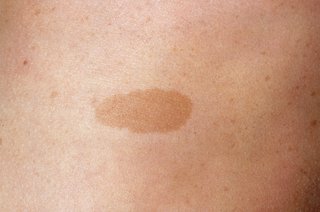
Cafe-au-lait spots:
- are low-cal or dark brown patches that tin be anywhere on the body
- are common, with many children often having i or two
- look darker on night skin
- tin be dissimilar sizes and shapes
- may be a sign of neurofibromatosis blazon one if a kid has half-dozen or more spots
Blueish-grey spots
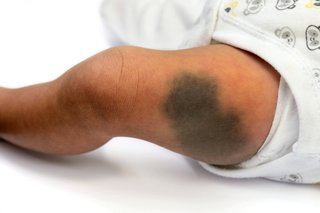
These birthmarks:
- can look blue-grey on the pare similar a bruise
- are frequently on the lower dorsum, bottom, arms or legs
- are there from birth
- are most common on babies with darker skin
- do not need treating and will commonly go away by the age of iv
- are not a sign of a health condition
If your baby is born with a blue-grey spot it should exist recorded on their medical record.
Brown or black moles (congenital moles or congenital melanocytic naevi)
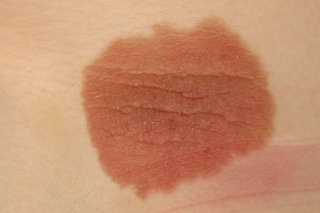
Congenital moles:
- are brown or black moles caused by an overgrowth of pigment cells in the skin
- look darker on dark skin
- tin become darker, raised and hairy, peculiarly during puberty
- may develop into skin cancer if they're large (the chance increases the larger they are)
- do not need to be treated unless at that place's a gamble of pare cancer
Data:
Find out about other types of birthmark:
The Birthmark Back up Group has information about other types of birthmark and getting help and support.
Non-urgent advice: Meet a GP if:
- you're worried about a birthmark
- a birthmark is close to the centre, nose, or mouth
- a birthmark has got bigger, darker or lumpier
- a birthmark is sore or painful
- your kid has half-dozen or more cafe-au-lait spots
- y'all or your child has a large congenital mole
The GP may ask you lot to cheque the birthmark for changes, or they may refer y'all to a peel specialist (dermatologist).
Information:
Coronavirus (COVID-19) update: how to contact a GP
It'south notwithstanding important to get help from a GP if you demand information technology. To contact your GP surgery:
- visit their website
- use the NHS App
- phone call them
Observe out nigh using the NHS during COVID-nineteen
Handling for birthmarks
Most birthmarks do not need treatment, but some do. This is why it's of import to get a birthmark checked if you're worried about it.
A birthmark can exist removed on the NHS if information technology'south affecting a person's health. If you want a birthmark removed for corrective reasons, you'll accept to pay to have it washed privately.
Possible treatments for birthmarks include:
- medicines – to reduce blood period to the birthmark, which can tiresome downwardly its growth and make it lighter in colour
- laser therapy – where heat and light are used to make the birthmark smaller and lighter (it works best if started between 6 months and 1 year of age)
- surgery – to remove the birthmark (but it can leave scarring)
Page last reviewed: 04 February 2020
Next review due: 04 Feb 2023
hannemancomativel.blogspot.com
Source: https://www.nhs.uk/conditions/birthmarks/
0 Response to "British Little Boy Who Thinks the Baby Will Be White Vine"
Post a Comment